If you own an e-commerce business or do any parcel shipping or delivery in Nepal, then you have probably come across many logistics terms every single day. Terms such as RTO, COD, and Manifest may seem intimidating and complex initially.
This guide aims to provide a layman’s dictionary for all the commonly used logistics terms in Nepalese shipments. The explanations provided in this logistics dictionary will be easy for all newcomers to understand and apply.
Why Understanding Logistics Terms Matters
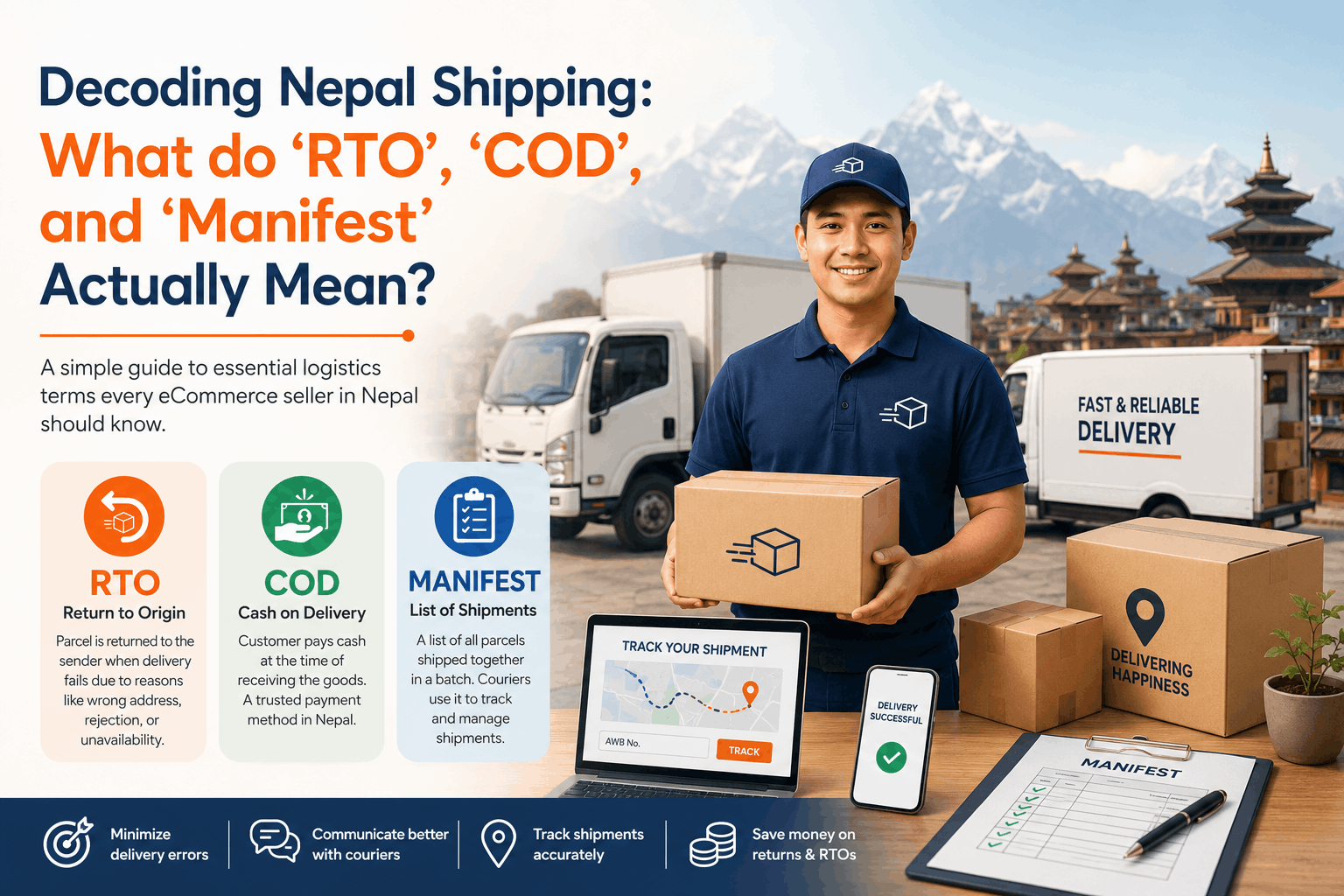
In Nepal, with the growth in eCommerce and the courier sector, understanding these terms will allow you to:
-
Minimize any delivery errors
-
Communicate better with the courier firms
-
Track your shipments accurately
-
Save money (particularly on return orders)
Logistics Dictionary (Simple Definition Boxes)
RTO (Return to Origin)
RTO takes place when the parcel is returned to its sender as it cannot be delivered due to reasons such as the buyer rejecting the order, providing an incorrect address, or unavailability.
COD (Cash on Delivery)
COD is a mode of transaction where the customer pays cash at the time of receiving the goods.
COD is a common method of payment used by many customers in Nepal.
Manifest
The term manifest refers to the list of all parcels which are shipped at once as a batch shipment.
Courier companies use manifest information to keep track of several shipments.
AWB (Air Waybill/Tracking No.)
AWB stands for air waybill or tracking number which is provided uniquely to each parcel.
Both the customers and sellers use this tracking number to trace the delivery status.
Pickup
The process of pickup involves the collection of parcels from your office or warehouse by the courier service company.
Most courier services in the Kathmandu Valley offer complimentary pickup services for business customers.
Delivery Attempt
The delivery attempt process involves the courier attempting to deliver the parcel.
When there is no person available to receive the parcel, it is considered a delivery failure.
NDR (Non-Delivery Report)
NDR is a type of report generated due to failure in the delivery process.
The reasons can be like “customer not accessible” or “incorrect address” and many more.
Forward Shipment
It is the regular shipment process from seller to buyer.
This is the first trip of your parcel before getting any sort of return.
Reverse Logistics
Reverse logistics refers to the process of returning products from consumer to the producer.
Return, exchange, and return to origin (RTO) are included in it.
Last Mile Delivery
The last mile delivery process is the final process of delivering the parcel.
This process is critical as it directly relates to customers’ happiness.
Hub
Definition: Hub is defined as an area where parcels get sorted.
It can be taken as a connecting point for parcels traveling from other cities and coming through a Kathmandu hub.
Transit
It refers to the journey of the parcel.
Your parcel will appear as “transiting” during your parcel tracking.
Proof of Delivery (POD)
Proof of Delivery (POD) is the confirmation about the successful delivery of your parcel.
It might include signature, OTP verification, or photo proof of delivery.
Volumetric Weight
Definition: Volumetric weight depends on the volume of the package rather than the weight alone.
Light items that occupy a lot of space will attract higher charges.
Same-Day Delivery
The item will be delivered on the same day it is collected.
It is mainly available for delivery within big cities such as Kathmandu.
Common Problems Caused by Not Understanding These Terms
Nepalese SMEs have many problems that arise because they lack knowledge of logistics terminologies:
-
High RTO rates due to poor communication with customer
-
Failure to comprehend COD settlement processes
-
Difficulties in parcel tracking because they do not know AWB numbers
-
Misunderstanding delivery delays during transit
Simple Tips for New eCommerce Sellers in Nepal
-
Double-check your client’s address to minimize RTOs
-
Use COD carefully and verify orders before sending goods
-
Track each package via AWB
-
Stay updated about the NDR changes and take action
-
Partner with a trustworthy courier service
Final Thoughts
Logistics does not have to be difficult. As soon as you familiarize yourself with all the basic terms such as RTO, COD, and Manifest, everything will become easy for you to handle.
In a nutshell, you can view this article as the Nepal shipping shortcut. Regardless of whether you are dealing with your first parcel or hundreds of packages, you know everything now.
For those who run an eCommerce business in Nepal and use couriers, knowing this terminology will go a long way in ensuring success.
FAQs: Nepal Shipping & Courier Terms
What is RTO in courier service in Nepal?
RTO stands for "Return to Origin," which implies that the package is returned to the seller because there was an error with delivery due to the wrong address, refusal, or unavailability of the customer.
Why do RTO orders happen in Nepal eCommerce delivery?
The reasons for RTO include wrong address details, fraud orders, unavailability of the customer for calls, and non-acceptance of COD packages. It is essential to minimize RTO orders to reduce costs.
What does COD mean in Nepal courier service?
Cash on Delivery (COD) refers to the method where the buyer receives the product and pays for it immediately at the delivery point. This term is widely used in Nepal, as a lot of buyers want to make payments after receiving their order.
How does Cash on Delivery (COD) work in Nepal?
In COD orders, the courier collects cash from the customer and later transfers it to the seller. The process includes order confirmation, shipment, delivery, and payment settlement.