You bought something through an online store. You waited for it. Finally, the rider comes, and the package is squashed, wet, or you can hear that something inside it is smashed even before you open the package.
Now what?
Most buyers from Nepal do not understand what their rights are in such situations. Most sellers do not understand how to cope with such situations properly. There is a quarrel, nothing is resolved, and another disappointed customer vows to never buy anything online again.
This manual is intended both for sellers and for buyers. If you have received a damaged package or you are a seller facing complaints, here is everything about your rights, your responsibility, and actions you should take right after receiving a damaged package.
Types of Damages in Nepal's Parcels
Damages are not uniform, and understanding their types will guide your actions.
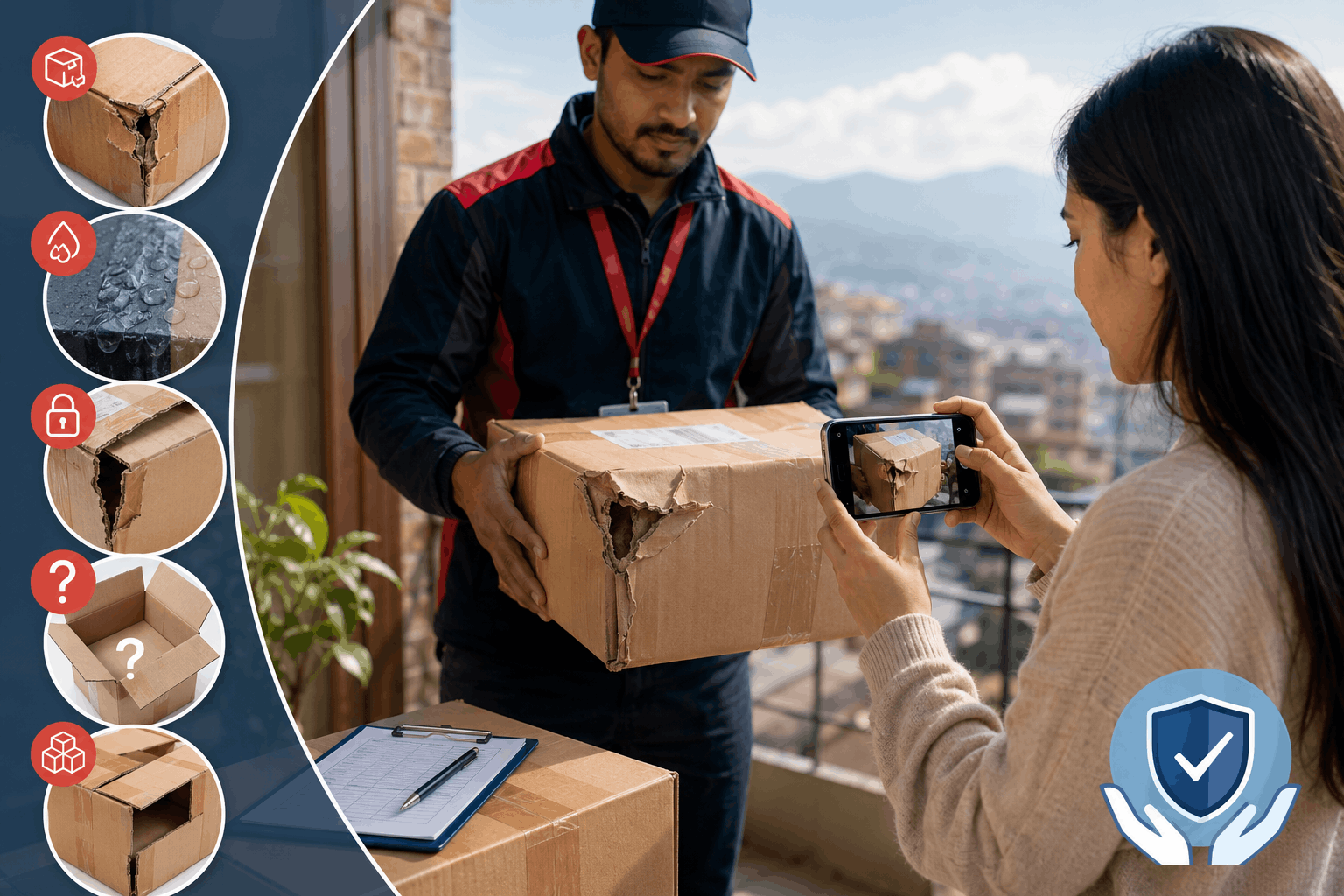
Physical damages involve receiving parcels that are crushed, torn, dented, etc., and products are damaged, broken, or bent. This type is the most frequent and easiest to photograph for claims.
Water/Moisture damages result when a package gets wet on its way to you. It is frequent in Nepal during the monsoon months of June to September, especially for deliveries that follow hilly/rugged terrain where parcels are transported in the open.
Tampering/opened packaging occurs when the security tape has been tampered with, and there are evident signs that the packaging was opened prior to its arrival to you. Products could be missing or moved inside.
Missing products occur when the packaging arrives without any issues, but certain products within are missing without any clarification from the carrier or the vendor.
Partial Delivery means that only certain parts of a multi-item order arrive without explanation regarding the remainder of the goods.
There is a bit of variation in the resolution for each of these cases, but the initial actions to take are the same.
Why Parcels Get Damaged During Delivery in Nepal
The topography of Nepal makes delivery difficult, unlike in areas that are completely flat. Knowing the reasons behind it will enable you to identify whether the damage could have been avoided and who might be responsible for it.
Mountain roads being bumpy is a huge contributor to why parcels become damaged. Any parcels delivered to the hilly districts will be exposed to vibrations and movement, which can easily cause damage to fragile goods despite being well-packaged.
Parcels that are exposed to monsoon rains will be affected if they are left in open transport means such as motorcycles, lorries, or other vehicles that travel on flooded roads. Without adequate waterproof packaging, any parcel that has been exposed to the elements will be ruined.
Improper packaging on the part of the sender is another reason that couriers cannot be blamed for damaging your parcels. Any item packed in a flimsy container with no padding is not the fault of the courier service.
Handling and loading of parcels during sorting and delivery is another common reason parcels end up getting damaged. Fragile items will be mixed with regular parcels without any caution during stacking or movement.
Overstacked vehicles on busy delivery days mean your parcel may have been under significant weight for hours.
Which Products Get Damaged Most During Delivery in Nepal?
All products have different levels of vulnerability during transit. Here are the following types of goods that are most prone to damage when being delivered in Nepal:
Electronic gadgets: Some examples of electronic goods that get damaged frequently while being delivered in Nepal include smartphones, laptops, earphones, and chargers. Such products can get damaged due to impact or exposure to moisture. Any slight mistreatment in the sorting center can internally damage such products. So if you are shipping any electronics, then double-pack them along with moisture-proof packaging.
Homewares: The fragile type of homewares includes products like glassware, ceramic mugs, photo frames, and other such fragile pieces. They are hard make it through Nepal's mountainous roads without breaking into pieces.
Food & Perishables: Increasingly being delivered using ecommerce services in Nepal, these products are extremely sensitive to delays. Even if they are packaged well, any problems with the road condition or failure of the first delivery attempt will lead to spoiling of the items.
Buyer Rights for Damaged Parcels in Nepal
Rights of buyers receiving parcels in Nepal include the following:
-
The right to check the parcel prior to signing for delivery. You cannot be forced to receive a parcel that appears damaged if you decide to examine it first. Ask the delivery person to wait until you finish the inspection.
-
The right to reject a damaged parcel at the time of delivery. If the damage to the parcel is clearly visible prior to opening the parcel, then you have the right to reject it. Such parcels become return to origin (RTO) cases, and the seller will be notified about this.
-
The right to take photos and videos of a damaged parcel prior to accepting it. This applies even if you decide to accept the parcel to check its contents.
-
It is within your rights to raise a formal complaint. There is always a complaints process in place at every genuine courier service in Nepal. It is your right to exercise it, and it is their duty to respond to it.
-
If the shipment comes under COD terms, you will gain more leverage. Do not pay if you haven’t paid for the order and find that it is damaged. Once you make payment,
the dispute becomes harder to solve. Refuse delivery or record evidence before making any payment.
Note on responsibility: In cases of prepaid shipments, the seller would be your first recourse. The seller raises the complaint with the courier. However, in cases of COD shipments, both parties share some responsibility. While the courier has delivered the shipment, they shoulder most of the responsibility in cases of damage.
Step-by-Step: What to Do Immediately When You Receive a Damaged Parcel
Perform these actions in sequence. The more documentation you acquire at the beginning, the higher the probability of a complete solution.
Step 1: Do not sign or pay until you inspect
Do not accept the parcel and sign the delivery document if it shows any signs of external damage. It is within your rights to examine the parcel.
Step 2: Take photos and video before opening the box
Photograph the outer package from all angles, particularly its damage, broken tape, dented corners, or water marks. These photographs will be crucial to your case. Consider making a video of you opening the box.
Step 3: Note your AWB/tracking number
The tracking number is printed on the label stuck on your package. You will need this information in all future communications.
Step 4: Contact the courier company within 24 hours
Inform the courier company about the damage as soon as you can. There is usually a window period during which you can lodge complaints against the courier companies. Provide the courier with the tracking number and pictures of the damaged goods.
Step 5: Contact the seller at the same time
You should contact the seller without waiting for the courier company’s response. Inform the seller about the problem and attach the photos and tracking number of the package. An ideal seller will initiate the process of coordination between the courier company and him/herself.
Step 6: File a formal written complaint if unresolved in 48 hours
If there is no resolution offered by either the courier service or the seller within 48 hours, it is time to take matters further. Request an official complaint reference number from the courier company.
For Sellers: How to Handle a Damage Complaint from Your Customer
When a buyer contacts you regarding a damaged consignment, the way you handle things within the next 30 minutes will determine whether or not you'll retain the buyer's business or lose them forever.
Acknowledge immediately. Do not wait to investigate before responding. Just send a brief response saying, "Thank you for informing us. We apologize for what happened, and we're investigating the matter." This is often enough to calm many buyers down.
Request photos and the AWB number if your buyer hasn't done so. You'll need the information to file a damage claim with your courier service.
File a damage claim with your courier. Use the AWB number, photos, and the date of the shipment when making the claim. Reputable couriers operating in Nepal have a procedure for handling damage claims.
Offer the buyer a resolution in parallel. Do not let the customer wait until the courier has investigated the matter and provided their verdict. Offering a replacement or a refund (whichever your company's policy requires) is appropriate for maintaining good relations with customers, and then recovering the loss from the courier service.
Understand courier liability. Although most courier contracts in Nepal include damages to cargo while in transit, they do not entertain claims where the packaging itself was insufficient. That is why packaging from your end is essential for your benefit and that of your customer.
How to Prevent Parcel Damage: Packing Tips for Nepal's Roads
Here are tips on how to package your items safely while shipping them to their destination through Nepal’s roads.
Pack fragile items in double boxes. Put the fragile item in one box with some padding around it, then put that box into a bigger box and add more cushioning between the two boxes.
Package all shipments for hilly or difficult areas to get to with waterproof wrapping. Place your shipment inside a waterproof bag or stretch wrap before placing it in the box.
Use correct padding. Do not use bubble wrap, foam, or even newspapers on just the upper side of the product; instead, use them on all sides. The product should not move within the box when jolted.
Indicate clearly. Label the box “Fragile” and “This Side Up.” Riders and personnel will actually pay attention to these labels.
Seal all sides. Seal the entire box, not just the upper side. Unsealed boxes that can open at the bottom end while in transit are a frequent source of damage.
Frequently Asked Questions (FAQs)
Can I refuse a damaged parcel in Nepal?
Yes, one can reject a package if it has been damaged outside prior to opening it. The rider will take it back as an RTO package, and the seller will be informed.
Who is responsible for a damaged parcel; the seller or the courier?
Depending on where the package was damaged, either party may be held accountable. For instance, if the seller wrapped the item poorly, the seller is at fault. However, if it was damaged during transit owing to mishandling or bad weather conditions, the courier is responsible. Practically, both parties are responsible for resolving the issue, and the seller must ensure that the customer is compensated first and then seek compensation from the courier.
How long does a damage claim take to resolve in Nepal?
This varies depending on the courier company used. Generally, it takes between 3 to 7 working days from when you file your claim using the AWB number and pictures.
What if the courier denies my damage claim?
Request in writing the rejection letter along with the reason. In case you think that the decision is unfair, you can escalate your complaint to the management of the courier company or to their head of customer care services. Remember, as a business owner, you have more bargaining power as compared to an individual.
Is there a time limit to report parcel damage in Nepal?
Most courier companies need to report any damaged parcel within 24 to 48 hours of delivery. Delaying beyond this period makes your claim less credible because of the difficulties in proving that the damage was caused by the courier.
What if items are missing from the box but it wasn't visibly damaged?
It is considered a case of tampering or pilferage. Note down the items delivered against what you ordered, take pictures of the package, especially the seal and the tape, and get in touch with both the carrier and the seller using your AWB number.
How NCN Delivery Handles Damage Claims
At NCN Delivery, each parcel undergoes a standardized handling process in every route that we have. Whether the parcels are being transported in Kathmandu city or even the remotest districts, we use the same protocol in handling them. In case of a damage complaint, NCN Delivery will use a three-pronged approach: verification through AWB information and riders, investigation of the damage through the appropriate hub/transit location, and finally informing both the buyers and sellers through a formal report on the issue.
Have you received a damaged parcel through NCN Delivery or a seller wishing to file a damage complaint? Get in touch with our customer support team by giving us the necessary details, including the parcel’s AWB number and photos.
For sellers who are looking for a courier partner that gives top priority to the safety of parcels, register with NCN now.