Customer messages you: “Kurta does not fit me; I want to return it.” Or even worse, “the case that came got damaged.” In either case, you will now be required to take the item back from the customer. If you are new to selling online in Nepal, this is when the concepts of reverse pickup and RTO tend to become confusing.
However, there is a difference between the two, and understanding it is quite important because it affects the liability of the product, the party that normally bears the costs associated with its pickup, and how you can configure your return policy right away.
What Is Reverse Pickup?
Reverse pickup simply means delivery done backwards. While in regular deliveries, the courier collects the parcel from you and delivers it to your client, in reverse pickup, the courier collects the parcel from your client’s location and delivers it back to you.
This technique is used whenever there is a need for the product to move backwards in the supply chain. The client will have the product in his/her hands; he/she will have received it, opened it, and maybe used it briefly.
Reverse Pickup vs RTO: They're Not the Same Thing
In these terms, most of the new sellers get confused. So it's worth spelling out clearly:
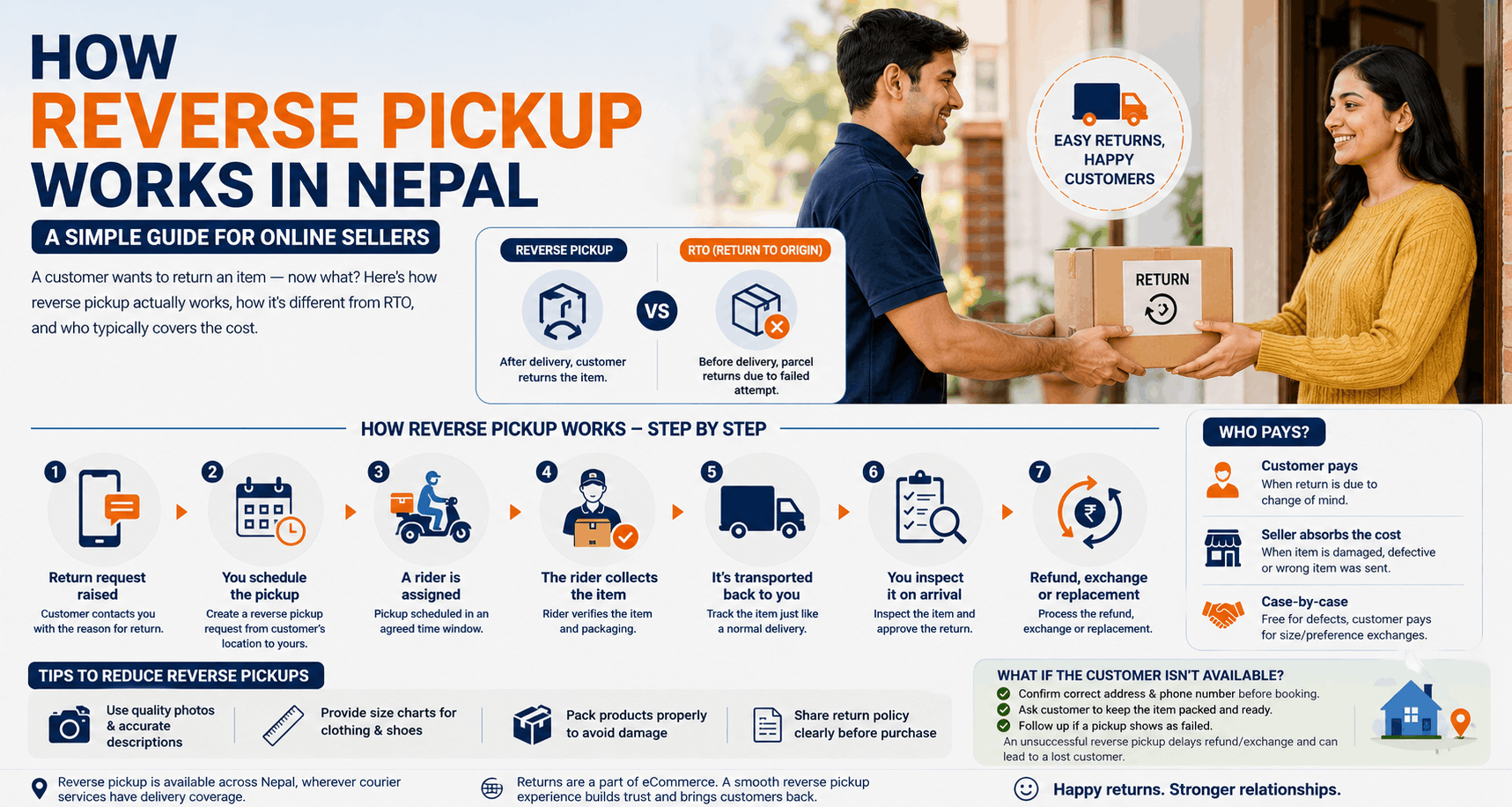
RTO (Return to Origin) process takes place before the product delivery to the client. An unsuccessful attempt to deliver the parcel takes place if the buyer rejects COD, doesn't answer his phone, provides wrong address information, or is not at home during delivery time.
A reverse pickup occurs after the client receives the item. The client accepted it, and now he wants to make a return, exchange, or get a replacement.
It is important to distinguish between these two operations because RTO is always an unsuccessful transaction that you try to avoid (if RTO is costing you more than returns, here's our guide on cutting it down.), while reverse pickup is the operation after a successful transaction when the buyer returns the goods.
When Do You Actually Need a Reverse Pickup?
Not all returns require pickup arrangements; some customers will bring their products to the store themselves. But reverse pickup comes into play if any of the following conditions are met:
-
There is a mismatch in size, color, or variant ordered
-
There is damage to the goods delivered
-
There is an error in delivery and a replacement/exchange must be sent
-
A new item needs to be delivered and the old one picked up from the customer first
-
The customer is making their return during the defined period as per company policy
For instance, if you are selling clothes, shoes, or electronics, you should anticipate this quite often since these items have a higher rate of returns compared to groceries or makeup.
How the Reverse Pickup Process Works, Step by Step
-
Return request raised
The consumer approaches you (or through your online form for returns/exchanges), outlining the reason why he/she wants to return the product.
-
You schedule the pickup
Just like you would create a pickup request for a normal delivery order, you create a reverse pickup request from the consumer’s end to yours, with the consumer’s address being the pickup location and your address/warehouse being the delivery destination.
-
A rider is assigned
The reverse pickup will happen at an agreed time window, in the same way that a normal pickup occurs.
-
The rider collects the item
A basic inspection will take place right at the door to see whether the product is available, if it is the product being returned, and if it is packed properly to be moved.
-
It's transported back to you
Track it just like a normal package to know the whereabouts of the product on route.
-
You inspect it on arrival
Process the refund, exchange, or replacement based on what you find.
The entire purpose of an effective reverse pickup service lies in the fact that there is absolutely no need for the customer to worry about packaging, booking the courier, or drop-off points, it is the process that builds trust.
Who Pays for a Reverse Pickup?
Again, there is no hard and fast rule, it will all depend on your policy towards returns, and mostly, Nepali sellers end up adopting one of the following three practices:
Customer pays: Common when the return is due to a change of mind rather than a fault with the product.
Seller absorbs the cost: Common when the product was damaged or defective or the wrong item was sent, since the mistake wasn't the customer's.
Case-by-case: Many sellers set a policy like free returns for defects; the customer covers the pickup fee for size/preference exchanges.
What Happens If the Customer Isn't Available for Pickup?
Like an unsuccessful delivery attempt, a reverse pickup attempt could also be unsuccessful due to the customer not being at home or unreachable via telephone or because the product isn't available on arrival. In such a case, it makes sense to:
-
Confirming the pickup address and phone number are correct before booking
-
Asking the customer to have the item packed and ready for the scheduled window
-
Following up if a pickup shows as failed, rather than waiting for the customer to notice
An unsuccessful reverse pickup means a delay in the refund or exchange of the item, which is what could turn a single return into a lost customer.
How to Cut Down on Reverse Pickup Requests
Returns are unavoidable, but there are things that can be done to decrease the number of reverse pickup requests:
-
Use quality photos and accurate descriptions: “this isn’t what I bought” is the cause of reverse pickups more often.
-
Provide a size chart if selling clothing or shoes
-
Package the products properly so that any damage during shipment doesn’t seem like manufacturing defects
-
Provide information about the return policy before the purchase is made
Frequently Asked Questions
What's the difference between reverse pickup and RTO?
RTO is when the delivery does not happen before the customer gets the item. Reverse pickup takes place once the customer has already got the item and is returning it.
Who pays for reverse pickup charges in Nepal?
This varies according to the return policy of the seller; some charge customers for preference returns and bear the costs themselves for defective products, while others have a fixed return policy regardless.
Can a reverse pickup request be cancelled?
Yes, generally speaking, as long as the pickup has not been completed yet, check with your courier partner on the cutoff for cancelling or rescheduling.
What if the customer isn't home when the rider arrives?
The pickup will be generally retried, similar to failed deliveries. Providing the correct address and contact information helps avoid this scenario.
Is reverse pickup available outside Kathmandu Valley?
Yes, anywhere NCN Delivery has a branch or delivery network, reverse pickups can typically be arranged the same way as a forward delivery.