If you sell online in Nepal and rely on Cash on Delivery, you probably had pain whenever a parcel comes back. You paid out for shipping it once, and then again to ship it back, you got no sale, and it's costing you more.
This frustrating cycle is known as RTO, or Return to Origin.
It occurs when a delivery attempt fails, and the package gets sent straight back to the seller. For eCommerce, small shops, and even Instagram sellers in Nepal, where COD is super common, RTOs represent a huge hidden cost.
But here’s something positive: many RTO issues can be avoided. This guide offers 10 proven strategies Nepal sellers can apply right away to cut their RTO rates, all tailored for the local market.
What is RTO and Why is it So High in Nepal?
RTO, short for Return to Origin, happens when a shipment can't be delivered and ends up back where it started. Typically, the courier tries to deliver your package a few times, but if they can't, it heads back to the sender.
This situation hits Nepalese sellers hard because they end up paying twice, once when sending out the package, and then again for the return trip. And that's not all; there's also the time lost from repackaging and dealing with stuck inventory. To top it off, there’s the potential for products to get damaged during the return journey. So, a single RTO incident could erase profits from several successful sales.
Now, globally, orders paid in cash on delivery (COD) tend to fail more than prepaid orders. Studies show that in South Asian eCommerce markets, COD returns can hit 20 to 40 percent, depending on stuff like the type of product, the seller's location, and whether the buyer confirmed the order beforehand. Nepal fits right into this scenario. For sellers dealing with lots of COD orders, a failure rate of 25 percent means they lose money on one in every four shipments.
The 5 Main Causes of RTO in Nepal
Understanding why RTOs occur is key to putting a stop to them. Here are the top five reasons for RTOs in Nepal:
Wrong or incomplete address:
Unlike India, Nepal hasn't got a standardized pin code system. Customers give their address using ward numbers, tole names, nearby chowks, or landmarks. If the delivery person doesn't get these right, forget it, the package won't get delivered.
Customer not available:
The buyer ordered something but wasn't around to receive it. Neither answers the door nor picks up the call.
COD refusal:
Sometimes customers change their minds and don't cancel the order beforehand. So, the rider brings it over, yet the buyer decides they won’t pay after all.
Customer not reachable:
The contact number provided during checkout is wrong, switched off, or is someone else's phone entirely.
Impulse orders:
People see stuff on social media, snap up an order without much thought, and regret it a couple days later when their item arrives.
The first four causes are largely fixable with simple process changes before you hand the parcel to the courier. The fifth requires a small change in how you handle COD orders at checkout.
How Much Does Each RTO Actually Cost You?
Here's what a typical Nepal eCommerce seller spends on COD deliveries:
|
Cost item |
Approximate amount (NPR) |
|
Forward shipping charge |
100 to 200 |
|
Return shipping charge |
100 to 150 |
|
Repackaging cost |
20 to 60 |
|
Time lost per order |
Variable |
|
Product if damaged in transit |
Full product cost |
|
Total loss per RTO |
220 to 410+ (before product cost) |
If 25 out of 100 orders return each month, that's NPR 5,500 to 10,000 spent on failed deliveries. The cash vanishes before profit enters the picture.
Strategy 1: Confirm Every COD Order Before Dispatch
To cut down on RTOs, the best move is to confirm every COD order before you send it off.
A lot of sellers avoid this since it seems like unnecessary work. Yet, a quick two-minute WhatsApp message could stop returns that cause extra trips and costs.
These confirmations work in two key ways. Firstly, they catch those impulse buys where buyers change their mind. This lets people easily cancel without the package even leaving, saving you money. Secondly, it lets you check the address beforehand, preventing attempts that fail because the info was incorrect.
So calling or messaging takes a bit of time, it saves headaches and costs later on.
WhatsApp Confirmation Message Template (English)
You should send it within a few hours of the order:
Hi [Customer Name], thanks for ordering from [Your Shop Name]. The [Product Name] you ordered, worth NPR [Amount], is set to ship via COD. Please confirm:
1. Is the address correct? [Paste their address]
2. Can you be at that spot in the next 2 to 3 days to receive and pay?
Reply YES to confirm or let us know if anything needs to be changed. Thank you!
WhatsApp Confirmation Message Template (Nepali)
नमस्ते [ग्राहकको नाम], [तपाईंको पसलको नाम] मा अर्डर गर्नुभएकोमा धन्यवाद। तपाईंको [उत्पादनको नाम] को अर्डर NPR [रकम] Cash on Delivery मा पठाउन तयार छ। कृपया निम्न कुरा पुष्टि गर्नुहोस्:
1. तपाईंको डेलिभरी ठेगाना सही छ? [ठेगाना]
2. २ देखि ३ दिनमा तपाईं घरमा हुनुहुन्छ र भुक्तान गर्न सक्नुहुन्छ?
YES भन्नुभयो भने हामी पठाउँछौं। धन्यवाद!
When to call instead of message:
For orders over NPR 2,000 or if a customer doesn't respond to WhatsApp in 12 hours, call them instead. Calls are harder to ignore, and you can solve issues right away on the phone.
Strategy 2: Fix the Address Problem
Nepal's address system is pretty informal. Many streets lack names and houses don't always have numbers. So when customers fill out their address on the order form, they often write stuff like "Balaju, near the school." The problem is riders struggle to find these spots without making a ton of calls.
A better solution is gathering more info when taking orders, while the address is still in your control.
So, make sure to ask for the ward number and municipality; this helps riders know which area to look in. Also, get the tole or locality name, a nearby landmark like a temple or school, and the customer's full phone number that'll be active during delivery hours.
Bonus points if customers drop a pin on Google Maps too; that's super helpful for those tough-to-find locations.
To streamline this, add these extra fields to your online order forms. If you take orders via Facebook or Instagram DMs, just set up a quick template that asks for all this information every time.
That way, the address is detailed and accurate right from the start!
How to use Google Maps pins via WhatsApp:
Ask the customer to open Google Maps, long-press their location to drop a pin, then tap Share and send it to you. Forward the pin straight to your courier on WhatsApp when setting up the delivery. This lets riders go straight to the spot, which is super handy in the Kathmandu Valley where customers usually have smartphones that make no address confusion at all!
Strategy 3: Send Real-Time Tracking Updates to Customers
One of the biggest reasons for failed deliveries in Nepal is that customers just forget about their incoming parcels. By the time the postman shows up, the customer might've completely forgotten their package until the moments before the knock at the door.
A neat fix? Sending a real-time tracking update the same day delivery's due.
This quick reminder via WhatsApp makes a huge difference: "Your parcel's coming today. Make sure to have NPR [amount] ready." In one short message, this check-in does several things. First, it refreshes the customer's memory. Next, it reminds them of the cash needed. Last, it gives them a chance to reschedule if they're unavailable, avoiding those pesky missed delivery attempts.
What works better in Nepal: SMS or WhatsApp?
WhatsApp is on almost every smartphone user’s in Nepal. People there check it often, though SMS can still reach those with feature phones. Open rates for SMS are way lower, though. For super important updates, like reminding someone about a delivery on the day it happens, use WhatsApp. If you can’t get in touch via WhatsApp, make a phone call. Your courier should offer tracking too. With NCN Delivery’s real-time tracking system, both you and the customer know where the package is at all times. Include that tracking link in your WhatsApp messages so customers feel good knowing when to be home for delivery.
Strategy 4: Set Honest Delivery Time Expectations
A frequent reason for Cash on Delivery refusal in Nepal is when sellers promise one thing and the customers experience something else. If you say an order will get there in two days and it shows up after five, the customer might just turn it away due to frustration.
In Nepal, delivery timelines can be a real challenge because of the country's geography. Within the Kathmandu Valley, same-day or next-day delivery works, and people expect that. For places like Pokhara, Butwal, Biratnagar, Dhangadhi, or those far-off hill areas, though, it takes longer. Road conditions, weather, and sorting at distribution hubs slow things down.
Simple timeline guide to share with customers:
|
Delivery zone |
Expected delivery time |
|
Within Kathmandu Valley |
Same day or next day |
|
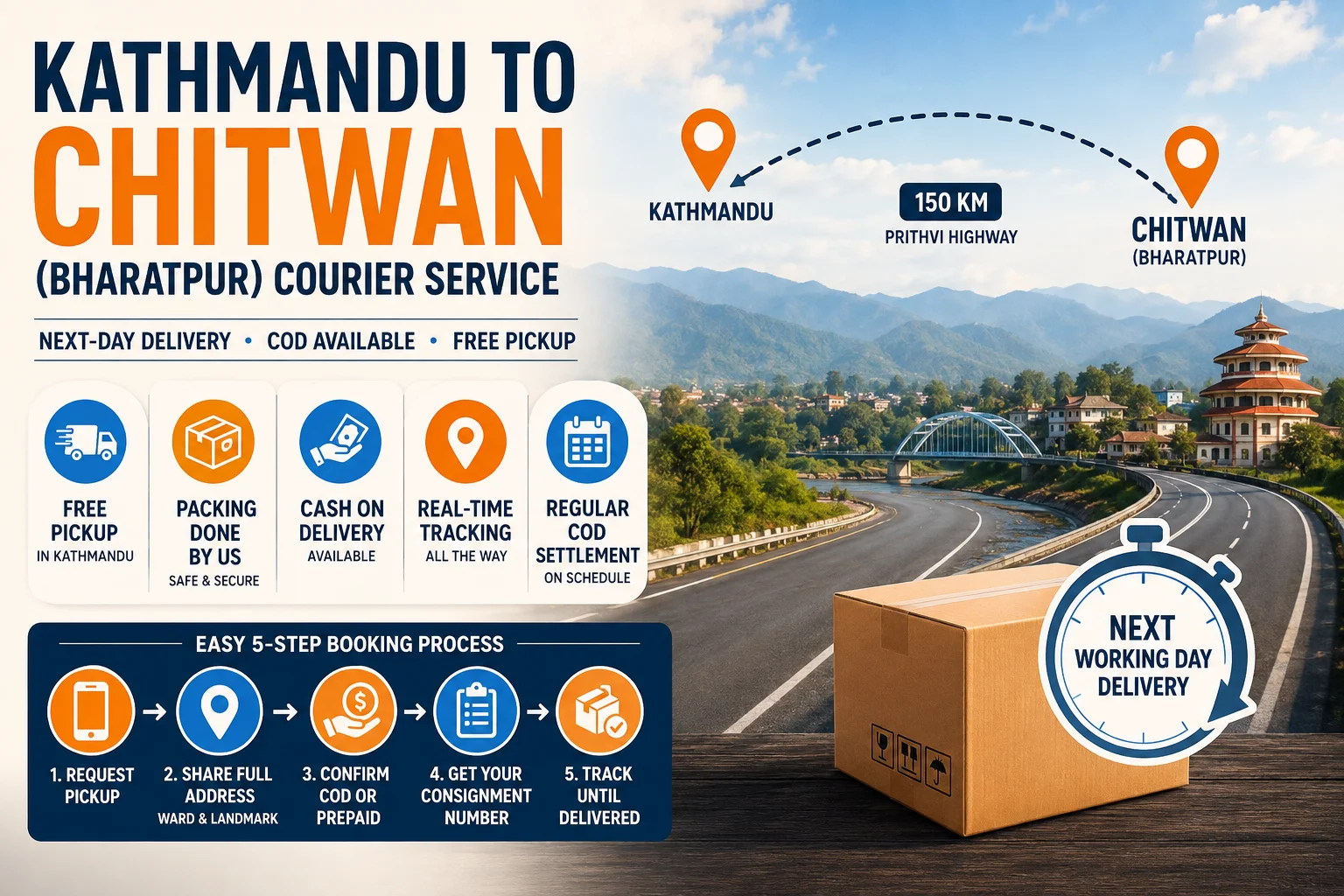
Pokhara, Chitwan, Bharatpur |
1 to 2 days |
|
Biratnagar, Dhangadhi, Butwal |
2 to 3 days |
|
Remote hill and mountain districts |
3 to 7 days depending on road access |
Make sure you set these expectations on your product page, in your order confirmation email, and once more in your dispatch notification. If customers know it takes four days and agree to it, they'll be around to receive the package. They won't be frustrated like those who thought it would arrive in two days.
To learn how packages navigate Nepal’s different terrains, check out our guide on Kathmandu vs remote delivery in Nepal.
Strategy 5: Handle NDR Alerts Fast
NDR stands for Non-Delivery Report - that's what couriers make when they can't drop off a package. They give reasons like the customer wasn't home, the address was wrong, or the person refused delivery. Most sellers don't even know what NDRs are or blow it off until the package starts coming back. That's totally missing an important chance to fix things.
What to do within 24 hours of receiving an NDR:
-
Call the customer immediately to find out what happened.
-
If they were not home, ask when they will be available and request a redelivery attempt for that time.
-
If the address was wrong, get the correct address and share it with the courier.
-
If the customer is having second thoughts, this is your chance to address their concern before they refuse the next attempt.
Courier companies like NCN Delivery typically make two or three delivery attempts before turning an order into RTO. Each hour you wait after getting an NDR means you're closer to the cutoff. Acting fast on NDR gives you the best shot at recovering the delivery.
You can learn more about what NDR and other courier terms mean in our logistics dictionary for Nepal.
Strategy 6: Write Accurate Product Descriptions
If customers feel misled by a product description, they often won't accept their delivery. This happens more than sellers think, particularly in fashion, electronics, and home goods. Issues usually stem from photos or descriptions that oversell what the item actually is. So, when the package shows up and the product falls short of expectations, customers refuse it right there or keep it and then complain.
Common gaps that cause post-delivery refusals:
-
Size or dimension not clearly mentioned (buyers assume based on the photo)
-
Colour appearing different in real life versus the product image
-
Material quality not described accurately
-
"As seen in photo" listings where the background item is more impressive than the actual product
Use precise measurements, actual color descriptions, and several pics in natural light. If your product has a known flaw, mention it too. Buyers who know exactly what they get are more likely to keep it.
Strategy 7: Give Customers a Reason to Pay Digitally
Orders where payment is due on delivery tend to have a higher return-to-order ratio compared to prepaid orders. With eSewa, Khalti, or bank transfers, customers who pay in advance feel more invested because they've already put money down. So, they're way more likely to be around for the delivery.
On the other hand, COD customers don’t lose anything by changing their minds and refusing the delivery. Still, you shouldn't get rid of COD altogether; many Nepali shoppers are used to trust issues and prefer it. Yet, offering a tiny incentive could boost those prepaid orders.
Simple prepaid incentives that work in Nepal:
-
A NPR 50 to 100 discount on eSewa or Khalti payments
-
Free delivery for prepaid orders while charging a tiny COD fee
-
Giving loyalty points or store credit for going digital
Shifting just 20 to 30% of COD orders to prepaid can noticeably lower the RTO rate.
For a deeper look at how COD and digital payments compare, read our article on COD vs digital payments in Nepal.
Strategy 8: Identify and Manage High-Risk Orders
Every order isn't equally risky when it comes to returns. You'll pick up patterns over time too. Some orders, places, or customer habits just tend to have more returns.
Warning signs of a high-risk COD order in Nepal:
-
The customer placed a large order for an expensive item with no prior purchase history with you
-
The delivery address is vague or missing basic landmark information
-
The phone number does not go through or is always switched off
-
The same address has come back as an RTO before
-
The customer placed multiple orders in a short time and you have no way to verify intent
Avoid problems by holding off on shipping if an address has already had returns. Or if someone quickly places several orders and you can't confirm their authenticity, play it safe and call them first. Try reaching out a few times over a day. If that doesn't work, it's best not to ship at all to avoid wasting time and resources on returns.
Keeping a simple high-risk customer list:
When using spreadsheets to manage orders, include a column for past RTO history. If someone refused delivery twice, they probably will again. Deal with high-risk orders proactively by asking for a partial advance payment or limiting their COD options.
Do this without totally banning them, though. Just be extra careful with those orders before they ship.
Strategy 9: Choose a Courier with Strong Last-Mile Reach
Picking the right courier is super important because even if you nail your end of the deal, a lousy courier could still ruin things. Issues like riders not trying to make contact after the first delivery failure or hubs that delay packages can mess up your returns.
What to look for in a courier partner:
-
Coverage that reaches your customers, including outside the Kathmandu Valley
-
Real-time tracking that you and your customer can access
-
A clear NDR management process where failed deliveries are followed up proactively
-
Multiple delivery attempts before converting to RTO
-
COD settlement timelines that work for your cash flow
-
A customer support line you can actually reach when something goes wrong
NCN Delivery runs an all-Nepal delivery network that covers both big cities and far-flung areas. We offer real-time tracking, COD settlement, and same-day delivery in the Kathmandu Valley. This is tailored for e-commerce sellers doing cash-on-delivery in Nepal. Sign up for a free account, and our team will help you out with NDR and last-mile deliveries in your zones. To learn more about choosing the right courier service, check out our comprehensive guide eCommerce delivery in Nepal for online sellers.
Strategy 10: Track Your RTO Rate Every Month and Set a Target
You can't fix what you don't measure. Lots of small sellers guess that returns are an issue, but they lack an actual figure. Without this number, there's no way to know if your actions are helping or not.
How to calculate your RTO rate:
RTO Rate = (Total RTO Orders / Total Shipped Orders) x 100
So if you shipped 200 orders last month and 50 came back, your RTO rate is 25 percent.
What is a good RTO rate for eCommerce in Nepal?
In Nepal, COD-heavy sellers typically see an RTO rate below 15 percent as strong. An RTO rate between 15 and 25 percent is usual for those lacking a formal confirmation process. If it goes above 30 percent, there's likely a big issue with order confirmation, address collection, or courier selection requiring urgent fixing.
Setting monthly targets helps a lot. Start by aiming to drop from 30 percent to 22 percent within a month. WhatsApp confirmations can make a difference. Follow up by shooting for 18 percent the next month with better address collection processes. Small, steady improvements really start adding up quickly.
Free RTO tracking method using Google Sheets:
Make a spreadsheet with five columns: Order ID, Dispatch Date, Delivery Status (either Delivered, RTO, or Pending), Reason for RTO, and Customer Phone. Update it once a week. Each month-end, just tally the RTO numbers, divide by total orders, and you get your rate. Also, check out the Reason column; you'll spot patterns that show exactly what needs fixing next.
Quick-Action RTO Reduction Checklist for Nepal Sellers
Use this checklist before every dispatch cycle:
-
Sent WhatsApp or call confirmation to every new COD order
-
Verified full delivery address including ward number and landmark
-
Collected and confirmed customer phone number is active
-
Set and communicated accurate delivery timeline based on destination
-
Shared tracking link with customer on the day of dispatch
-
Sent a same-day delivery reminder on the expected delivery date
-
Checked NDR alerts from previous day and followed up
-
Flagged any high-risk orders for manual review before dispatch
-
Reviewed last month's RTO rate and reason breakdown
Frequently Asked Questions About RTO in Nepal
What is a good RTO rate for eCommerce in Nepal?
A good RTO rate for eCommerce sellers using COD in Nepal is below 15 percent. Many sellers, though, don't have a structured order confirmation process and end up with rates between 20 and 30 percent. Rates above 30 percent usually mean issues like no pre-dispatch confirmations, wrong addresses, or deliveries going out of the courier’s reliable areas.
Who pays the return shipping cost when an RTO happens?
When an RTO happens, the seller in Nepal typically covers both the initial shipping and the return costs. How this works differs from one courier to another. Some charge a set fee per shipment that includes returns, while others bill you separately. It's smart to ask your courier for details on their RTO charges before you begin shipping so you can plan the costs into your prices.
Can I refuse to take back an RTO parcel?
You can't refuse an RTO parcel once it's been sent. You've gotta take it back at your registered pickup address. The stuff's still yours. But if it gets lost or damaged on the way, talk to your courier company about filing a claim based on their damage and loss policy. Check out our guide for more details on what to do if your parcel is damaged during delivery in Nepal
How do I know if a COD order in Nepal is fake or high-risk?
To spot a fake or risky cash-on-delivery order in Nepal, look for these clues: a phone number that doesn't pick up after several tries, a vague address with no recognizable landmarks, a huge order from a new customer, or an order placed at weird hours, followed by no response to your confirmations. If your order shows two or more of these red flags, give them a call before shipping it out.
How does NCN Delivery handle failed delivery attempts?
When a delivery fails, NCN Delivery sends an NDR explaining why. Then, our team tries again with the customer, keeping the seller updated throughout. Both seller and customer stay informed at every step. In real time, sellers can check their shipments on the NCN tracking portal. For more details on our COD and return management, check out our COD delivery service page. You can also register for a seller account to chat directly with our team.
Final Thoughts
RTO is a regular part of running an eCommerce business in Nepal. Every seller deals with it, but a high RTO rate isn't something you just accept because it's a problem that has specific causes and can be fixed with specific solutions.
Start by confirming every cash on delivery order before you even think about dispatching it. Also, make sure to collect a full delivery address that includes the ward number and a recognizable landmark. Just implementing these two things can noticeably reduce your RTO rate within the first month.
After that, add in tracking updates, set honest delivery timelines, and follow up quickly on no delivery attempts. With a few months of consistent effort around three to four months,you'll develop a system that weeds out bad orders early and resolves most issues before they turn into RTOs.